Case Histories, by Kate Atkinson
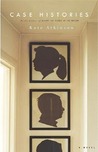 Case Histories by Kate Atkinson
My rating: 1 of 5 stars
This book certainly is not one that "sparkles with. . . page turning delight," no matter what the jacket description says. I don't really understand its point, either. It can't be the mystery portion, which is wan, or the character studies, which would be laughable if they weren't so grotesque. Perhaps Atkinson is trying to present sketches of misery and loss so readers can compare the characters' situations with their own, and say to themselves, "hey, if they found something worthwhile in life after so much suffering and woe after woe, I guess I shouldn't complain." Personally, I am not interested in studying comparative wretchedness. If I were, I would focus on nonfictional accounts, as there are more than enough. But if I didn't already know there is always hope and the promise of something better, I wouldn't be on this earth anymore.
Unfortunately, Atkinson is a competent story crafter, so after the first chapter (the book's most engaging and intriguing), I really wanted to see what the answer to the mystery was. But the first thing I did was check to see if there was a formula to the structure of the book that would allow me to skip reading the rest of it just to find out the resolution of that particular case history. (I never do that!) I quickly saw that past the laying out of the three case histories (four, if you count the detective's own life story) in the first four chapters, the novel entangled them all. So there was nothing left but to press on and slog through the whole book.
I admit that a couple of times I laughed out loud at a particular situation (an awkwardly named cat, for example), and there was one time I was brought to teariness (but I'm a sap). But in general, I was rather disgusted, and very little of that had to do with the sometimes morbid crimes. I am an avid reader of both true and fictional crime stories, so I'm not easily shocked. Here, I was revolted most by the way Atkinson sees people. I feel sorry for her if she thinks there are people out there whose inner lives run in the fashion she writes Amelia Land. Ms. Atkinson seems, in her attempt to write a narrow-minded, prim character, rather narrow-minded and cruel herself. The only respite is Amelia's relationship with her sister: believably quarrelsome, but with an inalterable true bond. However the relationship is barely visible, only expressed in a few moments of comfort or care.
Most of Atkinson's characters are caricatures of human nature rather than any true, fully formed depiction. It makes me feel as though she has no perception of or intuition about people at all. It's a sad realization about any author, but especially here, considering this novel is undoubtedly supposed to be an exploration into the private thoughts of a collection of people, linked by happenstance, a detective, and the fact that they are all victims of a crime of one sort or another.
The exception to the insipid, parochial portrayal of characters is Jackson Brodie, the detective. He feels real, has believable thoughts and emotions, and you care about him, although he acts like an idiot on occasion. Paradoxically, his own "mystery" is the most ludicrously cliche.
There's also a couple of charming little girls, and a vivid character interviewed over the space of about a page and a half. Not too much time is spent on the little girls, either: they are mostly present to create situations or show the relationship other characters have with children. I find it incredibly odd that though Kate Atkinson is a woman, her likable and believable characters are a man and little girls. It's odder still that while her little girls are inhabitably real, her mothers are all out of sorts, incapable of properly mothering, spiteful, disconnected from children, and regretful of their own motherhood. Of course some mothers are this way, but all? Looking at the book now and thinking of its depiction of motherhood, the image it conjures is grey and sickening. The childless women aren't much better off in Atkinson's world. In fact, it seems she cannot create a woman who isn't uselessly self-serving or the sexual plaything of a man, or both. If the women aren't one or both of those, they are distant and indistinctly drawn.
As for the crimes themselves, they aren't anything unique or particularly interesting. If the characters painted through the method of using the crimes as introduction were worthwhile, that would be fine. But since the characters are horrible, bland stereotypes, the crimes' mundanity stands out as well. If you are a halfway decent armchair detective, everything you could possibly figure out, you quickly do. The ultimate conclusions are unsatisfying, banal, stupid, silly, and fantastical.
While I found that I had to keep reading after the first chapter, I wouldn't recommend this book to anyone. Not only is it a dismal read, the quality of the writing isn't pleasurable either. While Atkinson can on occasion make events interesting, there is no magic or mastery in her words, and she has irritating syntactic quirks that serve no purpose. She's also one of those authors who, finding a word they feel is interesting, use it until it's a beaten husk. Two of Ms. Atkinson's favorites: leveret (used bizarrely) and anchorite. Sheesh with the anchorite already! In spite of the few incidental wry smiles, I got no enjoyment at all from reading this book, and even found myself handling it the way I do a very stained, mildewy old library book although it was in fine condition. It was readable, but in a word, grim.
View all my reviews on Goodreads
Labels: book review, books, detective, fiction, mysteries, not recommended, reviews
posted by blue @ 9:25 AM
0 comments


0 Comments:
Post a Comment
<< Home